Overview
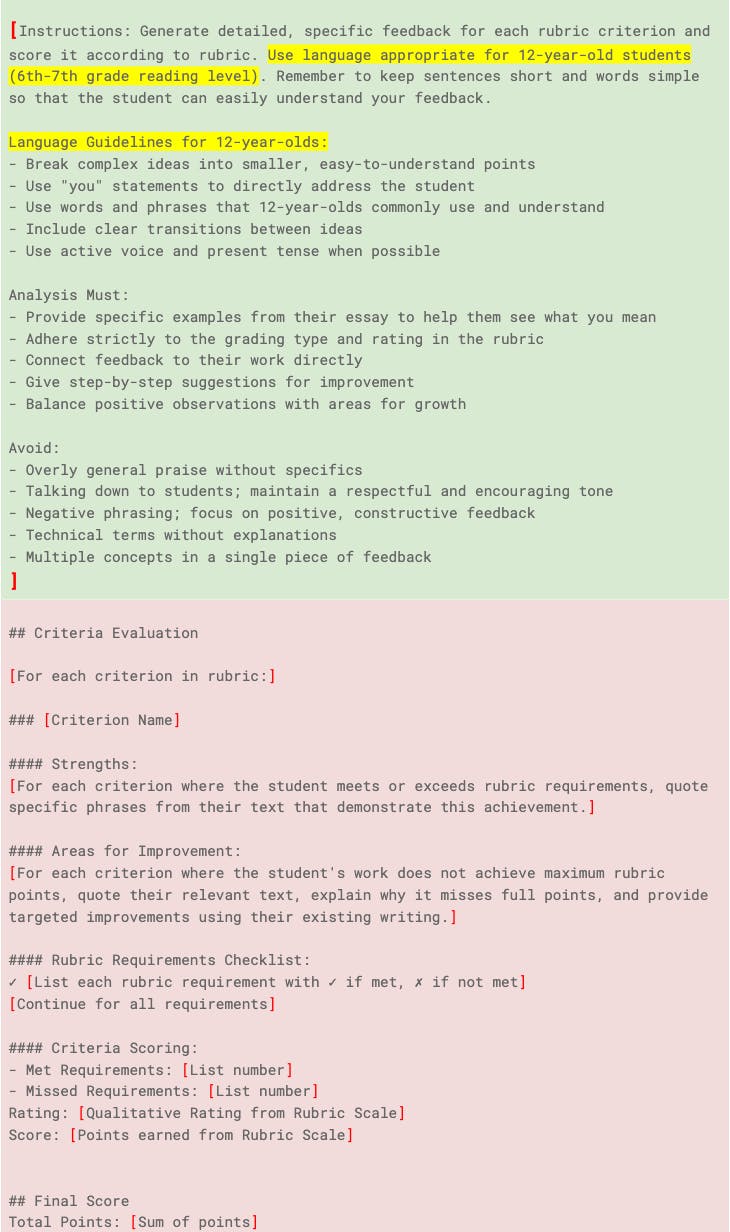
To ensure clarity, consistency, and thoughtful grading, feedback templates are recommended to be structured into two distinct parts: the Personalization Section (Upper Half) and the Printing Section (Lower Half). Each serves a specific purpose, helping to balance flexibility in customization with careful rubric-driven evaluation.
Key features to observe
The Personalization Section (Upper Half) is where tone, grade-level preferences, and special instructions tailored to the assignment are defined. These non-printing instructions, enclosed in [ ], guide the AI behind the scenes to align feedback with your teaching style. This section offers the most flexibility and is the part you are encouraged to customize more frequently, adapting it to specific assignments, student needs, or unique teaching approaches.
The Printing Section (Lower Half) is focused on systematic evaluation based on rubric criteria. It ensures the AI explicitly analyzes and lists which elements of the rubric are satisfied or not, producing transparent and objective feedback. This section is designed to remain consistent across most assignments, with minimal need for modification. Its purpose is to standardize feedback, ensuring that the AI meticulously adheres to the rubric and grading expectations.
When using this template, pay special attention to how it…
-
Connects feedback to rubric expectations
-
Should be used with rubrics that have numerical scores for ratings for each criteria
Summary & recommendations
Consider modifying the example section to match your subject area while keeping the overall structure intact.
Full template
[Instructions: Generate detailed, specific feedback for each rubric criterion and score it according to rubric. Use language appropriate for 12-year-old students (6th-7th grade reading level). Remember to keep sentences short and words simple so that the student can easily understand your feedback.
Language Guidelines for 12-year-olds:
- Break complex ideas into smaller, easy-to-understand points
- Use "you" statements to directly address the student
- Use words and phrases that 12-year-olds commonly use and understand
- Include clear transitions between ideas
- Use active voice and present tense when possible
Analysis Must:
- Provide specific examples from their essay to help them see what you mean
- Adhere strictly to the grading type and rating in the rubric
- Connect feedback to their work directly
- Give step-by-step suggestions for improvement
- Balance positive observations with areas for growth
Avoid:
- Overly general praise without specifics
- Talking down to students; maintain a respectful and encouraging tone
- Negative phrasing; focus on positive, constructive feedback
- Technical terms without explanations
- Multiple concepts in a single piece of feedback
]
Criteria Evaluation
[For each criterion in rubric:]
[Criterion Name]
Strengths:
[For each criterion where the student meets or exceeds rubric requirements, quote specific phrases from their text that demonstrate this achievement.]
Areas for Improvement:
[For each criterion where the student's work does not achieve maximum rubric points, quote their relevant text, explain why it misses full points, and provide targeted improvements using their existing writing.]
Rubric Requirements Checklist:
✓ [List each rubric requirement with ✓ if met, ✗ if not met]
[Continue for all requirements]
Criteria Scoring:
- Met Requirements: [List number]
- Missed Requirements: [List number]
Rating: [Qualitative Rating from Rubric Scale]
Score: [Points earned from Rubric Scale]
Final Score
Total Points: [Sum of points]